Wednesday, June 21, 2017

Week 6 - Chile


PART 1. The Legacies of Dictatorship
Associated Readings
1.     Peter Winn, “Returning to Democracy,” selections
2.     Public Citizen, “The Uses of Chile: How Politics Trumped Truth in the Neo-Liberal Revision of Chile’s Development” (2006)
3.     Emily Achtenberg, “Elections in Chile: Confronting the Legacy of Dictatorship,” NACLA, pp. 20-22 (2016)

 Handouts ("Course Documents" on Bb)
  1. Handout 4. Chile Key Moments

NOTE: For one more week, I will rely more heavily than usual on PowerPoint slides to introduce you to recent history and key themes. When we get to Argentina (next week), I will return to a more narrative-heavy format on this blog.

I. Introduction to Chile
Please work your way through slides on Blackboard ("Chile Slides 1") in "Course Documents" content area. Then read the Winn, Public Citizen and Achtenberg articles.

Keep the Chile handout (Handout 4 on Blackboard) handy, especially as you get to the Achtenberg article where you can make connections between the history she tells and the key moments on the handout. Be sure to watch the clips included on the handout as well.

PART 2 - Student Movements
Associated Readings
1.     Nicolás Somma, “The Chilean student movement of 2011-2012: challenging the marketization of education,” Interface, pp. 296-309 (2012)
2.     Ximena de la Barra, “Chile: A Schizophrenic Country,” NACLA, pp. 23-27 (2016)

First read the Somma article, and then work your way through the second set of Chile slides (“Chile Slides 2”) on Blackboard. Finish off your engagement with Chile by reading de la Barra’s troubling and pessimistic text from last year. Keep in mind that your task here is to understand why the students in the clip (see slides) dressed up as zombies.


Sunday, June 18, 2017

Week 5 - Peru

PART 1. Introduction to Peru
Associated Readings

Readings
Peter Winn, “Peru’s Shining Path,” pp. 564-572
Cynthia McClintock, “Precarious Democracy and Dependent Development in a Divided Nation,” pp. 429-442

NOTE: This week and next (Peru and Chile), I will rely more heavily than usual on PowerPoint slides to introduce you to recent history and key themes. When we get to Argentina, I will return to a more narrative-heavy format on this blog.

I. Introduction to Peru
Please work your way through slides on Blackboard ("Peru Slides 1") in "Course Documents" content area.
 
II. The Shining Path and It's Legacies
Please work your way through slides on Blackboard ("Peru Slides 2") in "Course Documents" content area.
PART 2. Extraction and Mining
Associated Readings
Readings
Nicole Fabricant and Bret Gustafson, “Moving Beyond the Extractivism Debate, Imagining New Social Economies,” NACLA 48(3), pp. 40-45 (2016)
Heather Williams, “Peru’s Media-Friendly Mining Ban Conceals Toxic Inaction,” NACLA, pp. 58-63 (2016)
Raúl Zibechi, “Community Resistance Against Extraction,” NACLA, pp. 43-46 (2016)

Readings by Fabricant and Gustafson, Williams, and Zibechi give you a strong sense of how central debates around extraction and mining have become in present-day Peru (and elsewhere in the Andes). Indeed, mining is arguably the most important social, economic, and political issue in the region today, as it brings together major issues of development, environmental protection, and indigenous rights – and as you will see, these three agendas do not always align and tell us much about Latin America’s contemporary “post-pink” moment.

As you are getting started with the three associated readings, please watch the following short video from the New York Times (“Relocation in the Andes”), which tells of a new town being built by a Chinese mining company to which 5,000 people will be relocated.

Across Latin America, governments on left have joined those on right to promote policies that accelerate extractivism in its various forms. Such policies typically have the following characteristics: (a) They weaken regulatory, democratic, or environmental protection mechanisms; (b) They criminalize protest; and (c) They expand extraction into unconventional terrain (offshore oil fields, Brazil’s pre-salt reserves, Bolivia’s gas fields)

On the left, there are some countries who pursue mining and extraction with a semblance of more “redistributive” approach. The key examples here are Bolivia, Ecuador, Brazil, and Venezuela. As you will read, these cases exemplify the so-called “new” or “progressive” extractivism, claimed to be about sovereignty, anti-poverty, and public investment. Other countries pursue extraction in a more neoliberal line, focused on extraction for export, integration into the world market, and an embrace of foreign investment and privatization. This is the model that Peru currently falls into.

As the readings show, the reality of extractivism today is that it generates little employment (mostly for men), and it depends on ever-expanding frontiers (colonial mentalities, destructive attitude toward nature). As such, extractivism tends to view rural/indigenous communities as obstacles to national “need.”

Debates around extractivism are highly polarized, but there are many voices shaping the conversation. These include:
1.    The Ecological Left, which includes grassroots social movements, NGOs, and prominent leftist intellectuals
2.    Indigenous organizations, who typically embrace the pan-Andean notion of Pachamama (an earth spirit) and a spiritual foundation for opposition to extraction (i.e., seeing extractivism as a form of violence to nature which will result in Pachamama’s wrath)

As you are finishing up the readings, please have a look at this longer clip.

Sunday, June 11, 2017

Week 4 - Bolivia


PART 1. Evo Morales, Indigenous Mobilization, and Multicultural Citizenship
Associated Readings

  1. Peter Winn, “Children of the sun,” from Americas, pp. 261-269 (2006)
  2. José Garcia, “Bolivia: An indigenous movement consolidates power,” in Latin America: Its Problems and Its Promise, pp. 443-454 (2011)
 Handouts ("Course Documents" on Bb)
  1. Handout 3. Bolivia Key Dates
I. Introduction to Bolivia (Draws from World Scholar/Latin America & the Caribbean, 2011)
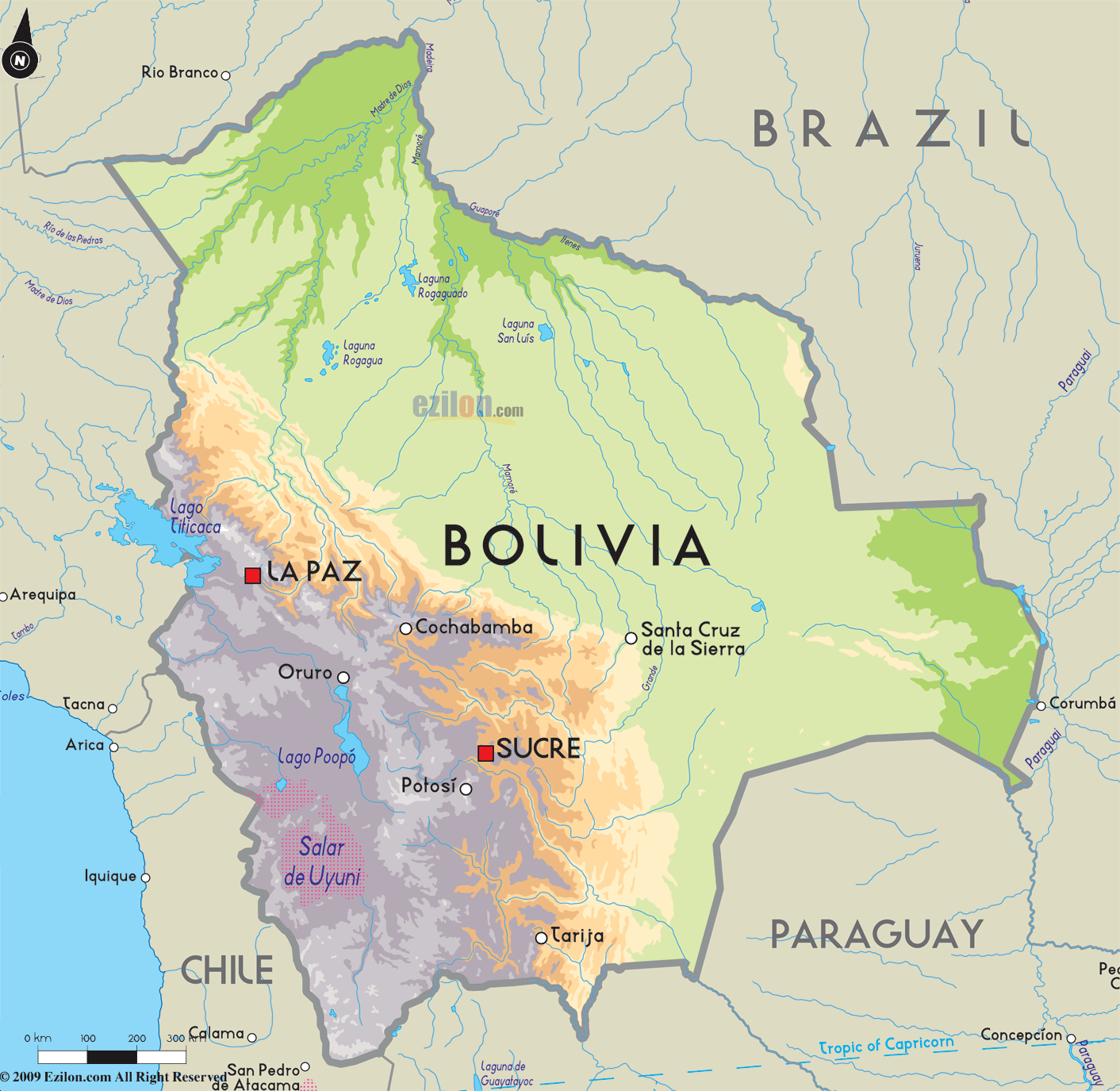
Bolivia is one of two entirely landlocked countries in South America, sharing borders with Brazil, Argentina, Paraguay (the other landlocked country), Chile, and Peru. Since the Andes mountain range runs through the center of Bolivia, mountain life is central to much of Bolivian culture. The country's diverse terrain includes the Altiplano (the high Andean plateau), valleys, and fertile lowlands.  You can see where the Altiplano is situated in the following map-image. Note that both of Bolivia's capitals (La Paz, where the president resides, and Sucre, where the judiciary is) are perched on the Altiplano.
Image result for bolivia

Having lived in this part of Bolivia myself for about six months in the early 1990s, I can say that the Altiplano's geography is remarkable. You can see the immensity of the Andean "high plains" in this photo of yours truly from back in the day:
In all, about one third of Bolivia is made up of mountainous and high-plateau areas and valleys, with the rest made up of lowland plains in the heart of the South American continent. Approximately 75% of Bolivia's population of 10.7 million live in the highlands, and more than 65% live in urban settings. 
Along with Peru and Ecuador, Bolivia is one of South America's primarily "indigenous nations." Indigenous peoples make up the largest demographic group, with almost all Bolivians claiming some indigenous heritage. The two largest indigenous groups are the Quechua and the Aymará. Bolivia's current president, Evo Morales, is an Aymará Indian and former coca farmer (more on this below).

In the following set of pictures, you can see some images of the Altiplano just outside the capital La Paz, of an Aymará festival, and of some focus group research I conducted with Aymará women about childhood respiratory illness:


II. Colonial History and Legacies
Prior to the arrival of the Spanish conquistadores in 1526, the area now known as Bolivia was under the rule of the massive Inca Empire. After the Spanish arrived, they soon established settlements. In the 1540s, the discovery of silver mines around the city of Potosí spurred migration and development. Much of the empire's wealth derived from these mines.  Here is Potosí:


Watch this 20-minute documentary about the mines today.

During Bolivia's early colonial period (roughly until the 1800s), it was ruled by "criollos," that is, locally born people of pure or mostly Spanish ancestry. Unlike countries like Brazil which had already begun to import African slaves, the basis for Bolivia's colonial economy was Indian labor and tribute. Criollo's were not aristocrats nor super-wealthy; and, they lived in the same areas where the Indians worked the mines.

Things started to change, however, in the 19th century, when silver mining declined (due to the exhaustion of silver reserves) and power began to shift to a landed aristocracy. (Tin and other minerals would be discovered later and mining would pick up again.) With the decline of silver mining, large-scale farming, primarily in the lowland areas, arose to take its place as the center of Bolivia's economy. The particular model of production followed--especially during the late 1800s--was that of the latifundio. As you may remember from my narrated slideshow from Week 2's blog entry, latifundios are giant, landed estates, and were typically large farms. In Bolivia, latifundios were owned by wealthy elites who typically resided in the cities (analogous to absentee landlords.) Under the previous system, land that Indians lived on was owned communally (by the Indians). In 1874, communal property became illegal in Bolivia, and huge tracts of land were transferred to wealthy elites. The Indians who worked latifundio farms were "bonded peasants"--not slaves and not legally bound to stay. What's more, Indians were increasingly paid money for their work. On the negative side, however, because Indians were now living on the land of the estate owner, they owed rent--placing them in a state of more or less permanent indebtedness.

In 1825, Bolivia became the last mainland colony to declare independence from Spain. In the following decades Bolivia suffered successive incursions and territorial losses as well as political unrest. In 1883, for example, Bolivia lost a war with Chile in the "War of the Pacific" and as a result lost its coastal territories. (Bolivia used to have coastline!) This loss remains a major sore spot for many Bolivians today.

An important point, before continuing: Throughout the colonial period and up until the mid-20th century, the primary non-white, non-mestizo category was "Indian" (indio). When plantation or mine owners looked upon their workers, they didn't see "slaves" and they didn't see pobres (poor people): They saw Indians. Similarly, Bolivia's various indigenous groups didn't identify in class terms, but rather in ethnic terms, as in, "We are Indians." I mention this because it all changed in 1952.

III. 1952 and the MNR Revolution (follows Handout 3 closely)
In 1952, Bolivia had a bona fide revolution that brought about major economic and social change as well as continued political turmoil. The revolution was fueled by the discontent of miners facing decades of exploitative working and living conditions and peasants caught in perpetual debt and without hope of saving money or owning land. Following massive strikes by unionized miners and land invasions by peasants (effectively bringing the national economy to a halt), a political party known as the National Revolutionary Movement (theMovimiento Nacionalista Revolucionario or MNR), rose to power.  What did the MNR do?
  1. They nationalized the tin mining industry. (That is, the federal government forcibly took it over from private groups.)
  2. They broke up the latifundio system. Large estates were expropriated and land parcels were given to peasants willing to work them.
The MNR government was not anti-capitalist. In fact, they promoted a form of "state capitalism" in which the federal government controlled capitalist economic development. While they had broken up several latifundios owned by elite families, they left alone many large-scale agricultural businesses.  What's more, they stimulated the development of agro-business by providing loans, technical support, and government subsidies for agro-businesses. They also encouraged highland Indians who had been working in the mines to switch to agricultural labor, so as to provide a workforce for the growing agro-business sector.

It was in these years--the middle decades of the 20th century--that the ethnic  category "Indian" (indio) which had been so fundamental to social relations became subsumed by another category: campesino. Those of you familiar with rural settings in Latin America may be familiar with this term. It is typically translated as "peasant." It differs from Indio in that it is a class-based rather than an ethnic term. Prior to the 1952 revolution, if you had asked a miner or farmer, "What group do you belong to?" the answer would have almost certainly been "Yo soy Indio" ("I am an Indian."). Post-revolution, the answer transformed into "Yo soy campesino" ("I am a peasant.") This shift from an ethnicity- to class-based identity had significant implications for social mobilizations in the decades to come. (More on this below.)

IV. Neoliberalism's Entry
From 1964 to 1982, Bolivia was controlled by military regimes (dictatorship by military generals), as was taking also taking place in neighboring countries such as Brazil, Chile, and Argentina. The 1970s were tough times for Bolivia's agricultural sector. During the military years, there had been little investment in the highland economy and it had become increasingly difficult for rural families to survive. As a result, the government undertook resettlement initiatives to encourage upland campesinos to move to the lowland areas, especially in Bolivia's southern region. The two areas that received the greatest influx of highland campesinos during these years were Santa Cruz and the Chaparé.  (Follow both of the preceding links to see where these two regions are located.)

Soon after the restoration of civilian rule with elections in 1982, Bolivia found itself in the same economic crisis that had been sweeping Latin America (beginning with Mexico's 1982 default on its international debt repayment). To get itself out of this crisis (i.e., to save enough money to maintain repayment of its own debt), Bolivia enacted structural adjustment policies emphasizing trade liberalization, privatization, and a general "opening up" of the national economy to the international market. In fact, it was the during the presidency of Victor Paz that Bolivia firmly embraced what would later be called a neoliberal model, emphazing the privatization of government corporations, reduction in state subsidies, and a diminished government role in social welfare. Google Victor Paz and see if you can discover why it was highly ironic that it was he who introduced neoliberalism in Bolivia. (If you can find out, squeeze the answer into one of your discussion board postings.)

The 1990s were a fascinating, complicated, and troubling decade for Bolivia.  As elsewhere in South America, Bolivia expanded its embrace of the neoliberal economic paradigm, especially under the presidency of Gonzalo Sanchez de Lozada, also known as "Goni." You'll learn a lot about Goni in this week's film, "Our Brand is Crisis" (although the film focuses on his second term).

V. Goni
In this week's readings, you will learn about some of Goni's major accomplishments, including constitutional reforms which redefined Bolivia as a “multi-ethnic and pluricultural nation." To us, his vision for Bolivia will likely seem paradoxical, since it emphasized both indigenous autonomy and neoliberal economic development. To understand this, consider the landmark 1994 "Law of Popular Participation." This law gave guaranteed that 20 percent of federal tax revenues would be transferred to Bolivia's municipalities (cities).  Moreover, it transferred substantial political power to the local level. With this influx of funds and power to cities, however, came enormous tasks. After the Law's passing, cities would now take on responsibility for maintaining services such as health, education, and systems of irrigation for agricultural plots. In effect, then, this Law ushered in the privatization of services for which the federal government had formerly been responsible. Have a look at the video clip below, which provides an optimistic, official government assessment of the "Law of Popular Participation":

By 2000, "privatization" had become a pejorative term for poor people in Bolivia. Check out the following clip to learn what happen when the water--all of the water--for Bolivia's third largest city, Cochabamba, was privatized (sold off to a San Francisco company):


In 2002, Goni was re-elected for a second term in office. As you will learn when you watch "Our Brand is Crisis," Goni attempted to sell of Bolivia's natural gas industry to a foreign company. For this, he paid a hefty price--nationwide protests leading to his eventual resignation in 2003.

If you have not yet watched "Our Brand is Crisis," watch it now.
VI. Evo Morales
Evo Morales, one of the first indigenous leaders of the country and a close personal friend of Hugo Chávez, was elected president in 2005. Have a look at this short dispatch from a New York Times journalist about the Morales campaign.

As mentioned above, Morales was a coca farmer before his political rise.
Here, it is important that you understand: Coca is not the same thing as cocaineCoca is a native South American plant, central to Andean cultural practices.  When chewed, coca acts as a mild stimulant and suppresses hunger, thirst, pain, and fatigue. (It also makes a nice tea.) With these properties, as you might guess, it is appealing and useful for people working in highland areas--and indeed is used by the vast majority of Aymará and Quechua Indians.

In the twenty-first century, international pressure for eradication of the coca crop has increased. Indigenous peoples in Bolivia have traditionally grown coca and chewed coca leaves, but illegal refinement of the crop into cocaine has drawn international criticism, including from the United States.

Now check him out on "The Daily Show" (2007 episode):

The Daily Show With Jon StewartMon - Thurs 11p / 10c
President Evo Morales
www.thedailyshow.com
Daily Show Full EpisodesPolitical Humor & Satire BlogThe Daily Show on Facebook

Morales instituted a program of redistribution of wealth to the poor and indigenous communities through land reform and greater government involvement in the natural gas industry. In February 2009 voters approved a new constitution that allowed for immediate presidential re-election. Later that year, Morales was re-elected for a five-year term. Political leaders in the eastern region of Bolivia, especially Santa Cruz, have been fierce opponents of the Morales administration. Since 2006 they have mobilized protests and staged referendums in favor of regional autonomy.  

Contemporary Bolivia has broken down along east-west lines in terms of economics, ethnicity, and politics, with the eastern lowlands populated by European descendants and the western highlands by mostly indigenous peoples, who became more politically active in the late twentieth century.

In short: Under Evo Morales, power in Bolivia has shifted away from a wealthy, outward-looking white minority that dominated Bolivian politics under the banner of neoliberalism, toward a much poorer, inward-looking indigenous majority excluded in recent decades from exercising power on a national scale.

PART 2. Meanings of Indigenous
Associated Readings

  1. Thomas Grisaffi, “After the Referendum: Evo Morales and the Movement Towards Socialism @FocaalBlog” (2015)
  2. Emily Achtenberg, “Evo's Bolivia at a Political Crossroads,” NACLA 48(4), pp. 372-380 (2016)
The articles by Grisaffi and by Achtenberg provide sobering updates on Evo Morales and the growing tensions between indigenous and Euro-descendant people in Bolivia. As Grisaffi explains:

Since 2005, Morales MAS party “has had many notable triumphs. The middle class has grown to encompass 10 percent of the population, economic growth is greater than it has been in decades, and there have been big advances in terms of civil and social rights. Cash transfers, a new minimum wage, and investment in health, basic infrastructure, and education have improved the lives of the poorest and most vulnerable sectors of society (Farthing and Kohl 2014). The figures speak for themselves; extreme poverty has fallen from 38 percent in 2005 to 17 percent in 2014, and the gap between the richest 10 per‐ cent and the poorest 10 percent has fallen from 128 to 39 times (BIF 2016).”

And yet, Achtenberg reminds us: “Bolivians have experienced their fair share of corruption, conflict, division, and poor planning, but on balance most Bolivians have done better under a left-leaning government.”

Grisaffi also gives us updates on Morales’s initiatives on maintaining coca production while supporting cocaine eradication efforts, summed up in Morale’s slogan “coca yes, cocaine no.” This campaign, Grisaffi report:

“has had surprising success. Morales definitively broke with the anti-narcotics model of the United States, replacing the militarized eradication of coca crops with a community-based coca control strategy. The new policy draws on the coca growers’ own distinction between coca leaf, which has been consumed by indigenous Andeans for millennia, and cocaine, the illicit drug. The strategy legalized the cultivation of a small amount of coca leaf in specific zones, encourages agricultural unions to self-police to ensure growers do not exceed this limit, and envisions the industrialization and export of coca-based products such as teas, hand cream, and toothpaste. The program has substantially reduced the coca crop while simultaneously respecting human rights and allowing farmers to diversify their livelihoods. In spite of the program’s benefits, US policymakers have remained steadfastly against this innovative approach (Grisaffi and Ledebur 2016).”

To better understand the story of coca eradication in Bolivia, have a look at this clip.

Achtenberg’s article shows us how mobilizations around natural resources have been central to social conflicts in Bolivia in recent years. In fact, this statement applies throughout South America, and especially in the Andes. (In Bolivia, you may remember this happened with the so-called “Water War” (2003) and “Gas Wars” (2005). These days, a major natural resource causing conflict is the range of minerals being mined. As Achtenberg writes, however, the Morales government has managed to successfully profit from mining, which has in turn benefitted Bolivia’s poor and indigenous people: “The vast increase in the value of Bolivia’s hydrocarbons and mineral exports has been largely recaptured by the state and redistributed to benefit the country’s poor and indigenous majority. Popular cash transfer programs for the elderly, schoolchildren, and pregnant women have markedly reduced poverty rates and improved living standards. Public investment—in schools, hospitals, roads, domestic gas connections, and other infrastructure projects—has increased eight-fold in 10 years. At the same time, under the banner of “decolonization,” the Morales government has granted constitutional and legal protections to indigenous groups and provided significant opportunities for educational and economic advancement by people of indigenous descent.”

In 2016—just last year!!—Morales supporters attempted to pass a referendum that would have allowed the president to run for an additional term in office. (The existing constitution allows for only two terms in office, and Morales is on his second term.) This attempt, however, failed. Please watch this short New York Times clip describing this defeat. Bolivia’s future, thus, is very uncertain – except that we know the next president will not be Morales.

Sunday, June 4, 2017

Week 3 - Venezuela

PARTS 1 and 2. Hugo Chavez and the Bolivarian Revolution

Associated Readings
  1. Tom Chodor, "The Bolivarian Revolution as Counter-Hegemonic Project." In Neoliberal Hegemony and the Pink Tide in Latin America, pp. 91-120
  2. Veronica Zubillaga, “The February Protests and the Unequal Experience of Violence — Cultural Anthropology” (2015)
  3. Iselin Åsedotter Strønen, “After the Bolivarian Revolution: What’s in Store for Margarita?” (2015)

Handouts ("Course Documents on Bb")
  1. Handout 2 ("Populism")
I. Introduction to Venezuela (Draws from World Scholar/Latin America & the Caribbean, 2011)

Venezuela, which shares borders with Colombia, Brazil, and Guyana, lies along the Caribbean Sea. Between the Andes Mountains in the northwest and the Guiana Highlands in the southeast lie central plains as well as a coastal region, with the country's climate varying from tropical to temperate.

Most U.S. citizens don’t know much about Venezuela. If they do, they may have heard about its recent--and very controversial--president, Hugo Chávez, who we’ll discuss at length below. Or, they might have heard of Simón Bolívar, a Venezuelan military and political leader who led multiple struggles in Latin America for independence from the Spanish Empire during the 19th century. And then there are the beauty pageants: In international competitions such as the Miss Universe competition, Venezuela continues to produce winners. Finally, many of you might buy gas at Citgo, which is owned by a major Venezuelan oil producer.

Colonial Past and Recent Political History
The Spanish established the first permanent settlement in Venezuela in 1522, but until the 1700s the colony remained largely undeveloped. Venezuela then became an important world producer of cacao, and Caracas emerged as a center of commerce. After several military battles with Spain under the leadership of Simón Bolívar, Venezuela declared independence in 1821. In 1830, the fledgling nation withdrew from its association with Colombia, Panama, and Ecuador in the Republic of Gran Colombia to become fully autonomous.

Throughout the nineteenth century Venezuela experienced many political upheavals. A series of authoritarian governments in the twentieth century brought more stability, with petroleum exports fueling economic expansion. In 1958, a two-party democratic system was introduced, but an economic crisis in the 1980s brought renewed unrest. In 1998, Hugo Chávez, who had been jailed six years earlier for his part in an unsuccessful coup, was elected president. I’ll have much more to say about this below.

Ethnicity and Cultural Practices
As is typical in Latin America, Spanish, native/indigenous, and African heritages have all contributed to Venezuelan life and culture, including language, art, food, and music. About half of today’s population is of mixed ethnic heritage, that is, mestizo or mulatto. About 85% of the national population (about 27 million as of 2011) live in urban areas in the northern portion of the country and currently resides in large cities such as the capital Caracas, cities that are concentrated in Venezuela's northern coastal mountain strip. Both life expectancy (73.9 years) and literacy rates (95.1%) are high. The vast majority (96%) of Venezuelans identify as Catholics, although many practice other forms of Christianity (for example, Evangelicals).

According to the World Refugee Survey 2008, published by the U.S. Committee for Refugees and Immigrants, Venezuela hosted a population of refugee and asylum seekers from Colombia numbering 252,200 in 2007. 10,600 new asylum seekers entered Venezuela in 2007. Between 500,000 and one million illegal immigrants are estimated to be living in the Venezuela.

II. Understanding Chavez and Chavismo 

In your readings from Week 1, you've already had an introduction to Venezuela's recently-deceased president, Hugo Chávez. The reading by Tom Chodor provides a detailed historical account of Chávez and his significance. As you may remember, Chavez became president after many years as a career military officer. During the 1980s, he increasingly opposed the government (and the Venezuelan political system more generally) which he found corrupt and undemocratic. In 1992, he led an unsuccessful coup attempt out of opposition to massive social spending cuts which had recently been made by the government in its structural adjustment initiatives. After two years, Chávez was released from prison and by 1998 had achieved popularity sufficient to get him elected president. An opposition movement attempted to remove him from power both through an unsuccessful military coup in 2002 and a recall referendum in 2003. The 2002 coup is the subject of the film you will watch during Week 3 (“The Revolution Will Not Be Televised”). During his time in office, Chavez was accused of manipulating the electoral process and instituting constitutional changes, including the end of presidential term limits, to retain power.

As president, Chávez undertook a massive social project known as the "Bolivarian Revolution," named after Venezuela’s most famous historical figure, Simón Bolívar. Following an ideology he and his followers called “Bolivarianism” and “Socialism for the 21st century,” his Bolivarian Revolution entailed the implementation of a new constitution, the formation of new initiatives in participatory democracy (more on this below), and the nationalization of several key industries (most notably, the oil industry). Chávez loyalists are known as Chavistas. If you have any friends from Venezuela, you will find out very quickly if they are Chavistas or not, as most Venezuelans have very strong feelings about this man!

A vocal critic of capitalism and in particular neoliberalism, Chávez was a prominent opponent of the United States' foreign policy, which he described as imperialistic. Allying himself strongly with the socialist governments of Fidel and then Raúl Castro in Cuba, Evo Morales in Bolivia, and Rafael Correa in Ecuador, his presidency was seen as a part of the leftist "pink tide" sweeping Latin America.

Advocating forms of direct, participatory democracy (rather than representative democracy), Chávez introduced a variety of initiatives which got ordinary citizens involved in decision-making around local resources. These initiatives included "Communal Councils" and worker-managed cooperatives. Funded from oil revenues, the Bolivarian missions aimed at expanding public services through the construction of free medical clinics, implementing educational programs to increase literacy, and administering food and housing subsidies to poor people.

I have prepared an hour-long video for you to watch called “Journey with the Revolution” (“Videos” tab on BB). As you will see, this film portrays the Bolivarian Revolution in glowing terms, showing multiple sectors of society who  became inspired by Chavez and for the first time in their lives  engaged in civic participation. This film lasts about an hour. Now is a good time to watch it.


III.  U.S. Perception of Chavez

To say relations between the U.S. government and Hugo Chávez were strained is an understatement. In the eyes of  mainstream politicians in the U.S., both Democrats and Republicans, Chávez was perceived of as an irritating troublemaker at best--and, at worst, a dangerous, undemocratic populist with ties to terrorist regimes elsewhere in the world. (See more on populism below.)


Watch Chávez's 2006 speech at the United Nations:

 
Now, a clip from his weekly TV broadcast, also from 2006, in which Chávez taunts President George W. Bush further:


Finally, here's Barbara 

Walters interviewing Chavez on ABC in 2007:


Chávez met U.S. President Barack Obama for the first time at the Summit of the Americas in 2009, where Chávez expressed a desire for better relations between the two countries. However, the Venezuelan president regularly engaged in anti-American rhetoric, and relations continue to be strained.

Please watch "The Revolution Will Not Be Televised" at this point, if you haven't already. 

IV. Understanding the Appeal of Chavez 
Even though Chavez passed away in 2013, his appeal and his followers remain strong, even as Venezuelan society becomes increasingly polarized. How do we account for the massive popularity of Hugo Chávez among Venezuela’s poor? Certainly, many poor people  welcomed Chávez’s use of oil revenues to fund social services such as health clinics and schools. But these material benefits alone are not sufficient to capture the distinctive appeal of this man’s style of leadership. To help better understand this, we’ll use a concept from political science (the IR majors among you are probably already familiar with it)--populism. While populist leaders aren’t limited to Latin America, some of the most well-known and heavily-studied populists have been from this part of the world. (The discussion below corresponds closely to the “populism” handout available under “Course Documents” in Bb.)

Let’s define populism as a style of leadership “characteristically involving a proclaimed rapport with ‘the people’, a ‘them-and-us’ mentality, and (often, though not necessarily) a period of crisis and mobilization” (Alan Knight, 1998).

Populist leadership is typically based on personal charisma and skills as an orator--leaders who know how to give a stirring and inspiring speech. Think of Chávez’s “You are a donkey, Mr. Danger!” performance from his weekly radio program (clip above).

Populist leaders seek a direct bond with their mass following. They lead personal movements rather than well-organized parties. Again, Chávez is a good example:  If you take him out of the "Bolivarian revolution," there would be nothing left.

Populism relies on mass mobilization--getting their followers out into the streets.

Populist leaders often have military backgrounds. Part of their appeal is that of the military caudillo, or strongman, who promises to deliver justice for the "people" by firm measures against the "exploiters."

When used to describe a leader, the term “populist” almost always has negative connotations. (Typically, it’s used to describe a politician who seeks popularity through appealing to the baser instincts of voters.) Historically, it is in Latin America where populism has had the greatest and most enduring influence. Its heyday was from the 1920s to the 1960s, as industrialization and the growth of cities got under way in the region. Against this backdrop, populism was the means by which the urban masses--the middle and working classes--were brought into the political system.


As you get a grasp on the concept of populism, resist the temptation to decide whether it is ultimately "good" or "bad." At the end of the day, populist leadership is deeply contradictory: On the one hand, it does focus attention on poor people rather than elites, but it can also create new elites. And, whether populism is good for democracy (think of Dahl's criteria, for example) is highly contested among academics.

V. Updates: Venezuela Under Nicolás Maduro

When Hugo Chávez died in 2013, his vice president and protégé Nicolás Maduro took over. In the ensuing four years, there has been a pattern of worsening economic trends and political corruption in Venezuela. This came to a sort of tipping point in 2014 when former beauty queen Monica Spear and her husband Henry Berry were brutally murdered. Spears represented all that is precious to many Venezuelans and showed the helplessness that characterizes precarious life in Venezuela these days. However, as Veronica Zubillaga reminds us in her article, most homicide victims are not middle-class folks, they are poor men.

On the protests that emerged after Spears’ murder, see this clip on the origins of the protests, this clip for some street scenes, and this clip for images of student protests specifically. Regarding the student protests specifically, it should be emphasized that the Venezuelan student movement is not unified, but instead represent a range of positions and discontents. As Zubillaga writes, “The students who are currently protesting represent the more radical members of this broader student movement opposed to the government. Their critiques against insecurity, the deterioration of the quality of life, and inflation are not unwarranted. Yet they play on Cold War anti-communist rhetoric, declaring that the democratically elected government that encourages popular democracy is “dictatorial.” They also blame the government for the proliferation of violence that is often linked to economic, paramilitary, and criminal networks hostile to the government, and for an economic crisis partly due to market mechanisms out of its control.”

You can see some recent updates on political life in Venezuela here, with the 2015 opposition’s successful outcomes in national elections and here with the 2016 attempt to recall President Maduro from power.

Finally, familiarize yourself with the story of Margarita, from Iselin Stronen’s assigned article. Margarita’s narrative shows you an grassroots leader’s experience with the Bolivarian Revolution, from early moments of excitement and inspiration to the current mood of alienation and cynicism.